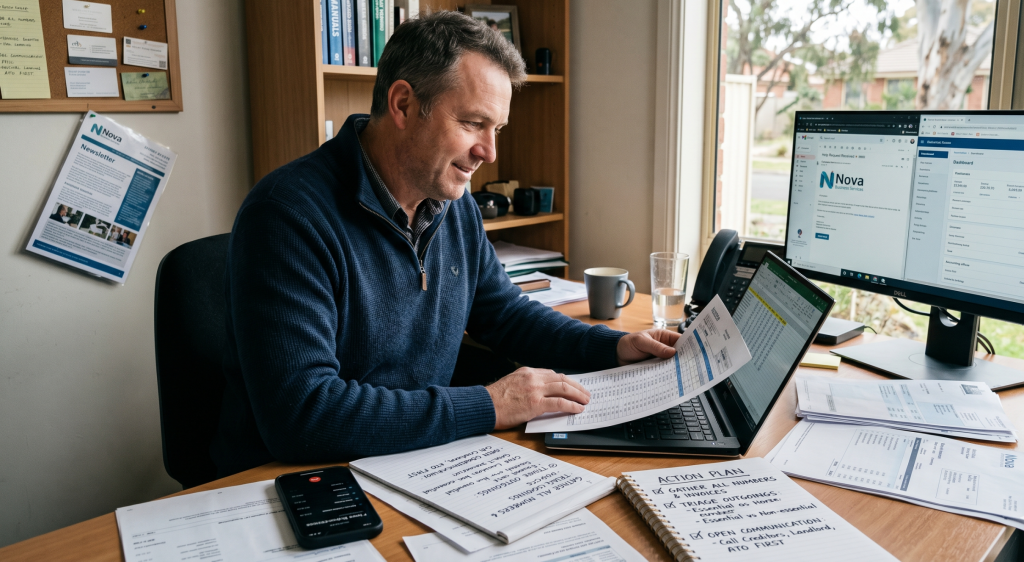
As Australians prepare to observe ANZAC Day this week, we are reminded of the power of endurance, mateship, and facing seemingly insurmountable odds. For small to medium business owners, financial struggles can often feel like an isolating and terrifying battle. Economic pressures, shifting markets, or unexpected expenses can suddenly leave you looking at a bank balance that simply does not add up.
The instinct to bury your head in the sand is entirely human. However, survival in business requires facing the reality of the situation head-on. If you have realised your business is in financial distress, your very first move should be to call a professional team, like Nova Business Services. We are here to carry the heavy administrative and financial burdens with you.
Once you have made that call, what comes next? Here are the first three steps you must take to stabilise your business.
Step One: Face the numbers objectively
When cash flow dries up, the most dangerous thing you can do is avoid your accounting software. You need a crystal-clear picture of your current financial standing. This means ensuring your bank feeds are reconciled up to the minute, identifying exactly who owes you money, and listing out exactly who you owe.
Write down your total liabilities, including your Australian Taxation Office debts, staff superannuation, supplier invoices, and rent. By quantifying the problem, you remove the fear of the unknown. It stops being a vague, looming disaster and becomes a tangible problem that you and your bookkeeping team can begin to solve.
Step Two: Triage your outgoing expenses
Think of this as financial first aid. You need to stop the bleeding immediately. Print out your last three months of bank statements and scrutinise every single line item. You must categorise your expenses into two distinct groups: what is essential to keep the business operating, and what is a luxury.
– Cancel unused or redundant software subscriptions.
– Pause marketing campaigns that are not currently delivering a measurable return on investment.
– Delay any planned capital expenditure or equipment upgrades.
– Review your utility providers and insurance premiums to see if you can negotiate a better rate.
The goal here is not to permanently downgrade your business, but to enter a temporary lean phase that preserves every possible dollar of cash flow.
Step Three: Open early lines of communication
Silence is the enemy of financial recovery. When you cannot pay a bill, avoiding the supplier’s phone call only damages your relationship and limits your options. Once you know your numbers and have trimmed your expenses, start making calls.
The ATO is actually far more accommodating than most business owners realise, provided you speak to them before a deadline is missed. They can often help you set up manageable payment plans for your Business Activity Statements or Pay As You Go withholding.
Similarly, speak to your landlord and your key suppliers. Explain that you are experiencing a temporary cash flow hurdle and propose a realistic payment plan based on the numbers you gathered in step one. Most suppliers would rather receive smaller, consistent payments than push a loyal client into insolvency.
You do not have to walk this road alone. The team at Nova Business Services has helped countless Australian businesses navigate turbulent financial waters. If your business is struggling, take a deep breath, and let us help you map out a path to recovery.
Our team is here to support you and your business in many different ways, give us a call on 1800 668 225 or reply to this blog by clicking here to ask us any questions.