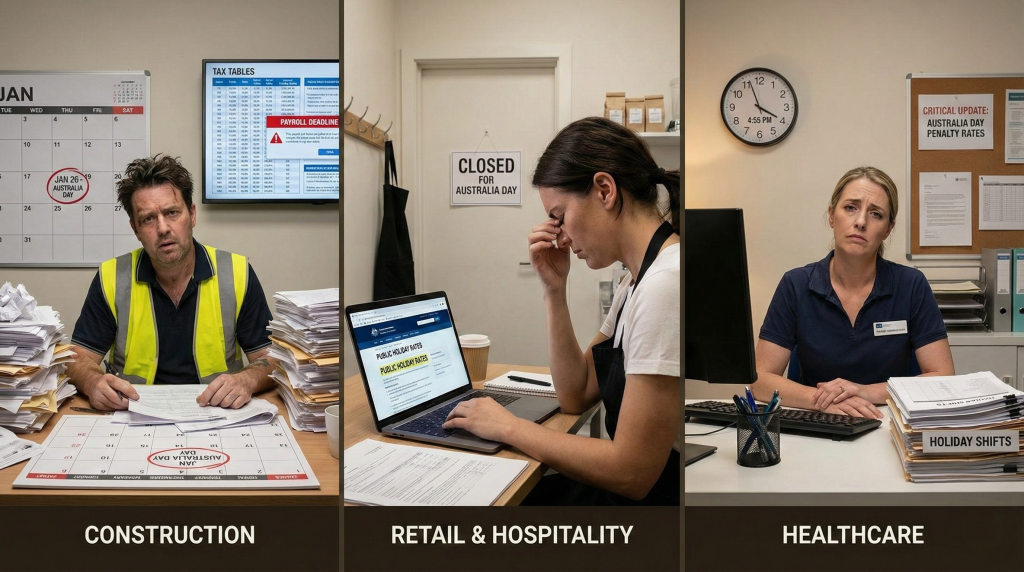
As the Australian summer heats up, so too does the anticipation for Australia Day on Monday, 26th January. For many, it’s a day of celebration, barbecues, and enjoying our beautiful country. For businesses, however, especially those operating in retail, hospitality, or essential services, it marks a critical juncture for payroll management and compliance. Understanding the intricacies of public holiday penalty rates is not just good practice; it’s a legal necessity that safeguards your business from potential financial penalties and reputational damage.
What Constitutes a Public Holiday for Payroll?
In Australia, public holidays are established by federal and state/territory governments. Australia Day consistently falls on 26th January. When this date falls on a weekend, a ‘substituted’ public holiday is often declared for the following Monday. For 2026, Australia Day conveniently falls on a Monday, simplifying things slightly by making the 26th January the observed public holiday across the nation. Businesses must recognise this day as distinct from a normal working day, triggering specific pay conditions for employees who work.
Decoding Penalty Rates
The core of public holiday payroll compliance lies in understanding penalty rates. These are higher rates of pay or additional loadings applied to employees working on public holidays, designed to compensate them for sacrificing their leisure time on a day when many others are not working. But it’s not a one-size-fits-all scenario:
– Modern Awards: The majority of Australian employees are covered by Modern Awards, which are industrial instruments that set minimum terms and conditions of employment, including public holiday penalty rates. These rates vary significantly between industries (e.g., General Retail Industry Award vs. Hospitality Industry (General) Award) and often specify different rates for various hours of the day (e.g., evening work), and different employment types (full-time, part-time, casual).
– Enterprise Agreements (EAs): Some businesses operate under an Enterprise Agreement, which is an agreement made directly between an employer and its employees about terms and conditions of employment. If an EA is in place, its provisions regarding public holidays will generally override those in a Modern Award, provided the employees are ‘better off overall’ compared to the relevant award.
– Casual Loading: Casual employees typically receive a casual loading (e.g., 25%) in lieu of entitlements like annual leave and sick leave. When a casual employee works on a public holiday, this casual loading is generally applied before the public holiday penalty rate, significantly increasing their hourly pay.
– Minimum Shift Payments: Many awards stipulate a minimum shift payment for employees who work on a public holiday (e.g., a minimum of 3 or 4 hours pay, even if they work less). This ensures employees are adequately compensated for coming in to work.
Key Compliance Considerations for Businesses
Navigating these complexities requires a systematic approach:
1. Identify the Correct Industrial Instrument: First and foremost, determine whether your employees are covered by a Modern Award or an Enterprise Agreement. The Fair Work Ombudsman website is an invaluable resource for identifying relevant awards.
2. Understand Employee Classifications: Clearly distinguish between full-time, part-time, and casual employees. Each category often has different entitlements and penalty rate calculations.
3. Accurate Time and Attendance Records: Meticulous record-keeping is non-negotiable. Ensure you have clear, auditable records of hours worked by each employee on the public holiday. This is crucial for demonstrating compliance and resolving any potential disputes.
4. Communication with Staff: Proactively communicate with your employees about their rostered hours and anticipated pay rates for Australia Day. Transparency helps manage expectations and fosters a positive working relationship.
5. Understanding ‘Reasonable Refusal’: Employees generally have a right to refuse to work on a public holiday if the request is not ‘reasonable’, or if their refusal is not ‘unreasonable’. What constitutes ‘reasonable’ depends on various factors, including the nature of the employer’s business, personal circumstances, and notice given.
6. Payroll Software Configuration: Ensure your payroll software is correctly configured to automatically calculate public holiday rates, including any casual loadings and minimum shift payments. Regular audits of your software’s calculations are advisable.
Common Pitfalls to Avoid
Businesses often fall into traps when dealing with public holidays:
– Assuming a Standard Rate: Believing all employees get the same penalty rate, or that it’s simply “double time”, without checking the specific award.
– Ignoring Casual Loading: Applying the penalty rate to the base rate without first adding the casual loading for casual employees.
– Overlooking Minimum Shifts: Paying only for actual hours worked, even if less than the award-mandated minimum shift for a public holiday.
– Poor Record Keeping: Lacking clear documentation to support payroll calculations, leaving businesses vulnerable during audits or disputes.
– Late Payroll Processing: Delaying the calculation and payment, leading to disgruntled employees and potential Fair Work issues.
Ensuring a Smooth Australia Day for Your Business
Proactive management is key. By taking the time now to review your payroll settings and understanding your obligations, you can ensure a compliant and stress-free Australia Day. Utilise resources from the Fair Work Ombudsman, consult your Modern Award, or better yet, engage with payroll experts.
At Nova Business Services, we specialise in untangling the complexities of Australian payroll and compliance. Our team is adept at interpreting awards, configuring payroll systems, and ensuring your business adheres to all public holiday requirements. Let us help you confidently navigate Australia Day payroll, so you can focus on running your business, not stressing over calculations.
Our team is here to support you and your business in many different ways, give us a call on 1800 668 225 or reply to this blog by clicking here to ask us any questions.